What if you could earn more than a traditional rental while avoiding some of the constant turnover of short-term stays?
That's one reason property owners are increasingly interested in mid-term rentals.
Short-term rentals can offer strong revenue potential, especially in high-demand markets. Long-term rentals can provide more predictable occupancy and income over an extended lease.
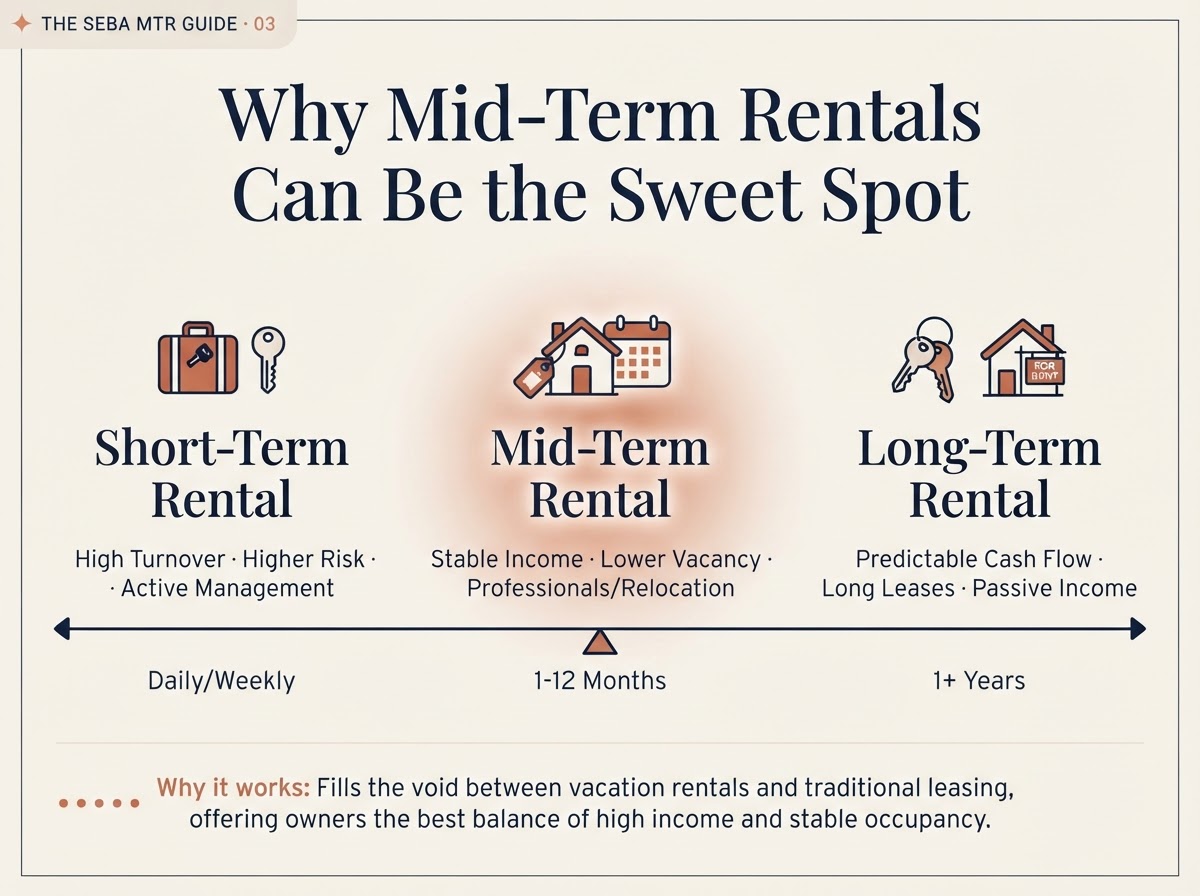
Mid-term rentals sit somewhere between the two.
They generally accommodate guests for a month or several months, although exact definitions vary by market.
For some owners, that creates an appealing balance between earning potential, flexibility, and consistency.
But every advantage comes with a trade-off.
Let's explore what makes this model interesting — and how to evaluate whether it makes financial sense. If you're still comparing the three models, start with our guide to short-term vs. mid-term vs. long-term rentals.
1. Finding the Balance Between Income and Stability
Different rental strategies offer different combinations of potential income, operating effort, and predictability.
Here's a simplified comparison:
| Short-Term Rental | Mid-Term Rental | Long-Term Rental | |
|---|---|---|---|
| Typical stay | Nights or weeks | One to several months | Several months to years |
| Pricing model | Usually nightly | Usually monthly | Usually monthly |
| Revenue potential | Can be high in strong markets | Can exceed traditional rent | Often lower gross rent than furnished alternatives |
| Income predictability | More exposed to frequent booking changes | Moderate; depends on booking length | Often more predictable during an active lease |
| Turnover | Frequent | Less frequent | Generally least frequent |
| Operating effort | Often high | Moderate, depending on services | Often lower turnover workload |
| Furnishings | Usually furnished | Usually furnished | Often unfurnished |
These are general tendencies, not guaranteed outcomes. A well-performing long-term rental can be more profitable than a poorly occupied short-term rental.
The important distinction
A short-term rental might earn the most during peak season but experience significant vacancies during slower months.
A long-term rental may earn less each month but provide a more consistent stream of contracted rent.
A mid-term rental may command a higher monthly rate than an unfurnished long-term lease while requiring fewer guest turnovers than a short-term rental.
That's the potential sweet spot: earning opportunities with a more manageable operating rhythm.
But to understand whether it's actually profitable, we need to look beyond the advertised rent.
2. Understanding the Numbers: Revenue, Costs, and Profit
You don't need to be an accountant to understand rental performance.
Start with a few essential terms.
Revenue — What your rental earns
Revenue is the income your rental generates before subtracting expenses.
For example, if your property earns $4,500 in rent during a month:
Monthly rental revenue = $4,500
This is not the amount you get to keep.
Operating costs — What it takes to run the rental
Operating costs are the expenses involved in keeping the property available and functioning.
They can include:
- Utilities and internet
- Cleaning
- Repairs and maintenance
- Landscaping and pest control
- Property management
- Booking commissions
- Insurance and property taxes
- Household supplies and replacement items
Some costs occur every month. Others happen only occasionally.
For a useful financial comparison, irregular expenses should be estimated over time rather than ignored.
Net operating income — What remains after operating expenses
Net Operating Income (NOI) = Operating Revenue − Operating Expenses
NOI measures the property's operating performance before financing costs and income taxes.
For example:
- Monthly operating revenue: $4,500
- Monthly operating expenses: $1,500
- Net operating income: $3,000
That $3,000 is not necessarily your final profit or spendable cash.
Cash flow — What's left after cash expenses
If you have a mortgage, loan payments also affect your cash flow.
For example:
- Net operating income: $3,000
- Monthly mortgage payment: $1,800
- Cash flow before other adjustments: $1,200
This simplified calculation excludes other possible cash outflows, such as capital improvements and income taxes.
Net profit — What the business actually earns
Net profit is an accounting measure of earnings after applicable expenses, including items not reflected in NOI.
It is not identical to cash flow.
For example, mortgage principal payments reduce cash but are not generally treated as an income-statement expense, while depreciation can reduce accounting profit without requiring a current cash payment.
The key takeaway: Revenue tells you how much comes in. Profitability and cash flow help you understand what you actually gain.
3. Putting the Three Rental Strategies Side by Side
Imagine the same property being operated under three different rental models.
The figures below are hypothetical and designed to illustrate how income and expenses interact. They are not market averages.
| Monthly average | STR | MTR | LTR |
|---|---|---|---|
| Rental revenue | $6,000 | $4,500 | $3,000 |
| Operating expenses | $2,800 | $1,500 | $600 |
| Net operating income | $3,200 | $3,000 | $2,400 |
At first glance, the short-term rental earns the most.
But look more closely.
The STR produces $1,500 more revenue than the MTR, yet only $200 more NOI in this example.
Why?
Because frequent cleaning, guest turnover, booking fees, utilities, and management can consume a larger portion of the revenue.
Meanwhile, the LTR produces less revenue but has fewer included services and lower operating expenses in this scenario.
Now consider occupancy
Those numbers only tell part of the story.
If the STR earns $6,000 in a strong month but significantly less during slower periods, its annual performance may change considerably.
Similarly, an MTR can experience a gap between multi-month reservations, while a long-term tenant may remain under a lease for an entire year.
That's why comparing one strong month can be misleading.
Compare annual performance, realistic vacancy, expenses, and cash flow — not just the highest possible monthly rate.
4. Longer Stays Can Mean Fewer Turnovers
Imagine managing eight separate short-term reservations in one month.
Each reservation may involve:
- Guest communication
- Check-in coordination
- Cleaning
- Inspections
- Restocking
- Preparing for the next arrival
Now imagine accommodating one guest for three months.
The number of guest transitions is dramatically different.
That can reduce turnover-related workload and expenses.
However, longer stays still require maintenance, communication, payment management, and occasional inspections.
Fewer turnovers don't mean no management. They mean a different kind of management.
5. More Flexibility Than a Traditional Long-Term Lease
A traditional long-term lease often provides greater occupancy predictability while the agreement remains in effect.
But it can also limit how quickly an owner can change pricing, availability, or the property's use.
Mid-term rentals can allow owners to reassess those decisions between shorter booking periods.
For example, a property could accommodate a three-month corporate assignment followed by a four-month relocation stay.
The trade-off is that shorter commitments can mean more frequent vacancy and marketing risk.
And all lease terms, renewals, and changes must comply with applicable laws and agreements.
6. Access to Different Types of Housing Demand
Mid-term rentals aren't limited to vacation demand.
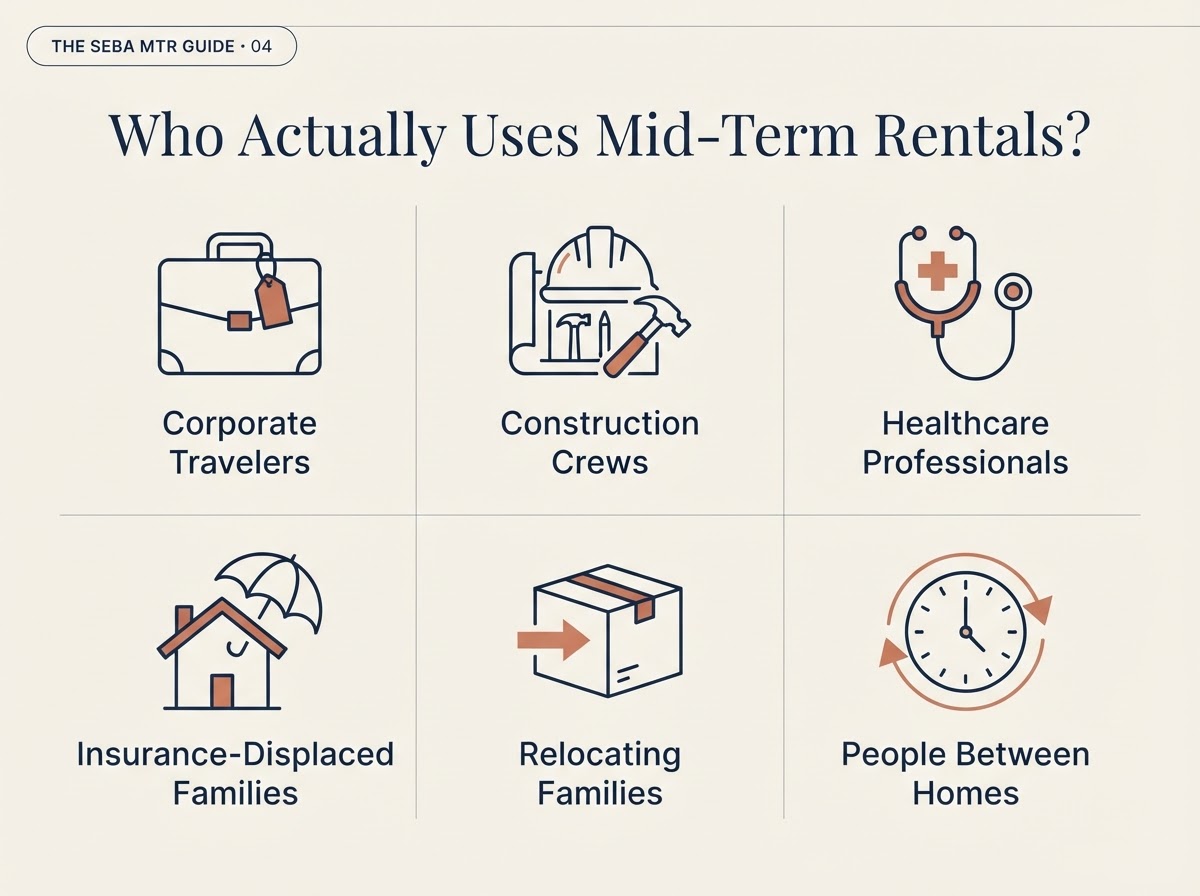
They can serve:
- Corporate professionals
- Construction and project crews
- Healthcare professionals
- Relocating families
- Insurance-displaced households
- People between permanent homes
These guests may need housing because of work assignments, relocation, repairs, or other temporary circumstances.
This can create opportunities outside traditional tourism markets.
But demand varies significantly by location.
A property near major employers, hospitals, or infrastructure projects may have different opportunities from a property in a primarily seasonal vacation destination.
7. So, When Is MTR Actually the Sweet Spot?
Mid-term rentals may be worth considering when:
- There is demonstrated demand for furnished monthly housing.
- Your property meets the needs of that market.
- The expected revenue justifies the additional operating costs.
- You value flexibility between reservations.
- You prefer fewer turnovers than a typical STR.
- You are comfortable managing longer-stay guest relationships.
The best rental strategy isn't necessarily the one with the highest advertised rent.
It's the one that produces a sustainable return at a level of risk and involvement you're comfortable with.
The Bottom Line
Short-term rentals may offer greater revenue potential in certain markets, but often with more frequent turnover and demand fluctuations.
Long-term rentals can offer more predictable contracted income, sometimes with lower gross monthly rent and fewer included services.
Mid-term rentals can offer a balance between the two.
The sweet spot isn't guaranteed by the rental category. It's created when demand, operating costs, occupancy, and financial goals align.
Explore Your Rental Strategy
Not sure which model fits your property?
Try SEBA Housing's Interactive Rental Strategy Scorecard, or compare realistic net income with our Turnover & Cost Comparison Calculator.